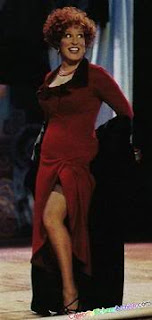
 Gypsy (Emile Ardolino, 1993): If I could wish for one Broadway show to receive the proper cinematic treatment, Gypsy would, without a doubt, be it. The show has been adapted twice--the 1962 version with Rosalind Russell and this one starring the one and only Bette Midler as Mama Rose--but neither have tapped into the epicness a really well-done film version could have. The 1962 adaptation was a generally pleasant experience thanks to director Mervyn LeRoy's invisible guiding hand, only slightly hindered by Russell's lack of vocal ability. With just a couple of changes, I thought for sure this 1993 version could vastly improve on it. That was my first mistake. Director Emile Ardolino is a complete slave to the stage version, barely attempting to even try and make this version of Gypsy film-appropriate; this could have been a filmed stage play and I wouldn't have noticed. The haphazard sets look like something straight out of a cheap high school production and could fall over and kill the actors on
 stage set with one good kick. The biggest disappointment, however, is Bette Midler's performance. True to form, she rips into the legendary score, belting out 'Rose's Turn' and 'Everything's Coming Up Roses' like the diva she is while adding an emotional depth that was lacking in Russell's performance. The real problem with Midler here is that she is outrageously over the top and stagy, almost to the point that I was afraid my TV wouldn't be able to contain her anymore. Bette is a naturally overbearing actress and has the tendency to over do her vocals and facial expressions, so she needs a director, even ones as middling as Garry Marshall or Kenny Ortega, to help her reign it in to fit within the film. Ardolino must have been in awe just to be directing a big star like Midler and too afraid of her to actually direct her. He ends up letting her run amok all over the film and she demolishes everything around her. Oh how I wish I was a studio executive right now and had the rights to this show. Just think the wonders that could be done to this show with a musical director who understands what makes a film musical different from the stage (think: Luhrmann, Rob Marshall, Adam Shankman, Kenny Ortega) and a film actress who can be both grandiose and larger than life without playing to the balcony like a stage ham (And, no, in my ideal version I would not cast a Broadway actress as Mama Rose. There are plenty of film actresses who can sing and act, thank you very much). Unfortunately, I don't know if I can trust Hollywood to correctly adapt such a tricky show; look how they fucked it up here. C
Henry V (Laurence Olivier, 1946): Look, I've already admitted that I'm not a fan of Shakespeare and think he's highly overrated (Boo hiss, yeah, I know I'm a neanderthal. Whatever) so I'm not exactly a fair judge when it comes to adaptations of his work. Usually, however, I can get the gist of what the play is about when I see it actually performed instead of simply reading the damn thing (people who enjoy reading his plays seriously deserve some kind of medal for their bravery and intelligence). Olivier's version of the play, with its static camerawork and long, drawn out takes, made it even more indecipherable--if that's even possible. Half the time, it felt like I was watching a foreign language film without the subtitles; people would just talk and talk gibberish for five, six minutes and I would have no clue what happened. The opening scenes on the stage were much better than anything that followed. The actors may have been playing to the audience too much for my taste (and I get that they were supposed to) but there was a surprising playfulness and sense of humor that was sorely missing from the rest of the film. There's a moment when some advisor and his assistant are reading from some documents, advising the King about something (I really have no idea what about) and the assistant keeps mixing up the papers and getting them out of order, causing the advisor to fumble and stumble trying to get the facts straight. I'm not sure if this moment is in the text (I seem to remember very few stage directions in his stuff), but I loved Olivier's take on it. He's seems to be entertaining a very liberal notion that you can play around with Shakespeare's work and even make a stuffy history lesson more enjoyable. I just wish the rest of this film was that inspired. C-
 Valentino (Ken Russell, 1977): Robert Osbourne, resident TCM host and purveyor of vast amounts of useless movie knowledge, introduced Ken Russell's grandiose biopic of the silent screen's tragic icon Rudolph Valentino as wildly inaccurate historically but reassured us that it was all for a larger, artistic purpose. I wasn't too fazed by this because earlier this year I had suffered through the clumsily inept and completely fictitious 1951 version of Valentino's life and nothing Russell could have concocted would be worse than that piece of dreck. True to Osbourne's word, Russell's Valentino isn't necessarily concerned with following Valentino's life from point A to point B. Rather, he seems more interested in discussing the intense fandom and celebrity mania surrounding movie stars. I find it fascinating that Russell decided to tackle this subject with a film set in 1920's Hollywood since it really could be considered the birth of our celebrity-obsessed media. There had been celebrities before, but never before had they been as readily available for public consumption as they had with the advent of the movies. Millions of people could see and fall in love with the same star at the same time and the hysteria surrounding these stars reached unheard of levels. Valentino depicts these stars responding to this madness in different ways, whether it's Nazimova living it up in diva fashion (Leslie Caron, of all actresses, absolutely nails this performance), playing to what her fans expect of her or Valentino himself, unsure of how to react to his sudden God-like status. Russell's film is absolutely beautiful to look at, preferring high art to realism in both sets and costumes. And, unlike with Tommy, the high class look fits much better in Valentino. Dancer Rudolph Nureyev stars as Valentino and although he's not a very good actor and adopts an accent reminiscent of Bellini ("Bellini, Bellini, you're not too skinny!") from Top Hat, he has the same kind of charisma that Valentino radiated from the screen (and it's not like Rudy himself was ever that great of an "actor" anyways). Russell's biopic may not be factual, but it's never dull and makes a greater point about celebrity and Valentino than any paint by numbers version of his life would have done. A-
 Trader Horn (W.S. Van Dyke, 1931): For a film almost completely devoid of plot (a good chunk of the film is spent with the main characters pointing out animals along the savanna) and inherently racist (at one point, one of the white characters says to a white woman captured by the "savage" Africans: "Don't you understand? White people need to help each other!"), Trader Horn wasn't half bad. For the time period, the sound design was impressive, mixing animal sounds into the soundtrack to heighten the realism. I loved MGM's decision to shoot the film in Africa, lending the cinematography a naturalistic quality lacking from many of the films of the era (Hallelujah! aside). I find the most interesting thing about the movie is the way the characters are presented. Harry Carey's worldly, experienced explorer is really more of an antihero than the full-fledged action star you would expect. Duncan Renaldo (a dead ringer for James Marsden) plays the romantic juvenile lead and is not as shallow or insipid as you would expect from a 1930's studio film. There are some great shots of him simply looking around his environment, taking it all in and possibly wondering how in the hell he got there. Nothing in Trader Horn completely works as well as it should, but it's such a fascinating mess I couldn't help but be absorbed. B-The Dresser (Peter Yates, 1983): What in the hell was this movie? A comedy without any laughs? A drama that doesn't make you feel anything? A head-to-head battle of veteran English actors that is more ham-handed and insipid than revelatory or exciting? It sure as hell beats me. I sat for two hours trying to dissect what was going on and nothing came to me. Albert Finney and Tom Courtenay star as Shakespearian actor and valet, respectively, preparing for a performance of King Lear after Finney has a mental breakdown and the aftermath of said performance. There is A LOT of talking going on in this movie but nothing ever seems to be said. Courtenay runs on and on about something and all I hear is "Blah blah blah I'm kinda gay" while Finney's lines all sound like "Blah blah blah I"m a self-important actor." The fact that this film earned Academy Award nominations by the score in 1983 is stunning while not so surprising all at the same time; I'm stunned that something so completely awful could be recognized for anything but not surprised since everything about the film (two respected British stars, World War II, Shakespeare, alcoholism, play-like structure) screams Oscar and their perspective on what qualifies as good filmmaking. D-
The darling of the gay film festival circuit last year, Tom Gustafson's Were the World Mine is a gay-themed, musical "re-imagining" of Shakespeare's A Midsummer Night's Dream. To say I hated this movie and completely don't understand how so many people, gay men in particular, find this wildly offensive, stupifyingly clichéd and transparent film to be interesting in any capacity would be a complete understatement. Just like every other film about a gay high schooler, the main character, Timothy (Tanner Cohen), plays a misunderstood loner in a private all-boys school who is harassed daily by most of the jocks. And I say most because, of course, there's the one über-attractive jock, Jonathon (Nathaniel David Becker), who doesn't pick on him that the main character automatically falls in love with (as we are shown in the main character's imaginary brief musical interlude where this character sings this high-pitched love ballad to him, sprawled out on top of a desk, wearing an open button down shirt with his twinky chest showing while a bunch of the other jocks do this excessively stylized ballet dance around him). Timothy also has an absent, unaccepting father and a mother who practically hates her son's homosexuality because it meant she had to leave her husband and go out and work (yeah, I don't know either), but he, of course, has his couple close friends that act as his surrogate family. Anything surprising or new yet? Didn't think so.Timothy's eccentric, Mrs. Darbus-esque English teacher is putting on the annual school play--a Taymore-inspired musical version of A Midsummer Night's Dream--which requires the participation of everyone in the class (boy, that sounds eerily reminscent of that kickass Gossip Girl episode where everyone had to act in the school's production of The Age of Innocence). Timothy gets the lead (shocking, I know), but finds it difficult to get the part just right, especially with all of the jock kids making fun of him in that not-so-subtle way that only happens in the movies. So, somehow, while practicing his lines one night, Timothy comes up with this magical potion that, when squirted in someone's face through this flower (kind of like in a porn when the guy shoots his load on someone else's face...although I wouldn't know about such things) turns the person gay and makes them fall immediately in love with the first person of the same sex they see. And, of course, since they are gay, they don't merely walk over to their desired love; oh no, that would be too easy and not gay enough. Instead, they have to glide over like a bunch of overeager ballerinas and start making out hardcore. Cut to the next scene where, in the background, instead of practicing the jocks are flitting about in a circle doing ballet moves in point shoes. Yes, I realize that this a movie with fantasy elements, but why is it that Gustafson feels the need to perpetuate the stereotype that because you're gay, you are artsy, can do ballet, must make out with someone within five minutes of meeting someone hot and are clingy and emotionally needy (there's a minor subplot where the macho, homophobic gym teacher gets sprayed with the potion and falls for the principal and ends up on his front porch, hoping he'll let him in and crying and blubbering like a rotten two year old). If you take out the musical numbers (which I must admit aren't too horrendous just overly theatrical and "pretty" for my taste), I really wouldn't have been surprised to hear that this film was made by one of the major studios with its backwards take on homosexuality, obvious story clichés, ridiculous wish fulfillment fantasy and ending I saw coming from a mile away. I wish I could say I'm surprised this is popular with so many of the "AfterElton" gays, but, then again, these are the same people who regularly think Latter Days and Big Eden are two of our community's greatest films. D
 Um...well, that sure was different.
After revealing my Shakespeare prejudice and proclaiming my love for Zeffirelli's 1968 version of Romeo and Juliet a couple of weeks ago, I was instructed in the comments to check out Luhrmann's 1996 version before making a definitive decision. I just watched it tonight and I must say that I'm still backing the Zeffirelli version whole-heartedly. Don't get me wrong, Luhrmann's vision and execution is impeccable and that opening scene-- a nearly post-apocalyptic version of a violence-torn city due to a grand feud between two wealthy families-- sucks you in so fast you almost have no idea what hits you.My biggest problem was that everything in William Shakespeare's Romeo + Juliet was so fucking loud. I could kinda deal with the loud sound effects because, in context, they made sense with Luhrmann's vision. But when all of the actors are just shouting their lines so much that you can hardly make sense of what they are saying, it begins to become sort of a problem. And let me just add something about the acting: I never thought I'd say this but sometimes Shakespeare should be left to the theatre experts. John Leguizamo had the potential to be great, but he spoke every damn line through a clenched jaw that I suppose was trying to show how badass he was but instead made it impossible to understand the words coming out of his mouth. Of the star crossed lovers, DiCaprio was better, but not by a wide margin. He was at least trying to get into the character and make the material seem fresh. Danes, on the other hand, played Juliet like just another random lovestruck teenager in some 90's teen romance instead of a first-class auteur's modern vision of one of the most recognizable love stories of all time.This brings me to another point. Watching this in 2008, as a child of the late 90's/early 2000's, the film already feels slightly dated. From the cheesy clothes and haircuts (which are very much of their time), to the romance (it didn't feel tragic enough to the point where they'd do anything for each other and I didn't feel any connection between DiCaprio and Dances and sort of wished they had cast someone like Kate Winslet to completely ignite the screen with chemistry) and the general debauchery and antics of all of the supporting cast which felt like it should belong in some fucked up hybrid of She's All That and Boyz 'N the Hood, everything felt completely 90's and almost kitschy. It will be interesting to see how this film fairs in 20 years: will people still love it or will it be a relic?I know this may sound like I hated this film, but, truly, I thought it was a very jarring and provoking experience (in a good way). It was exactly what I needed to see that not all Shakespeare adaptations need to be excessively theatrical and can be used to express an unique point of view. I sincerely think that this film needs to be shown as part of Shakespeare units in high schools to prove that his works are still relevant 400 years later. Well, look at that...maybe Luhrmann's converted me after all. B
My high school repeatedly tried to get me to read and enjoy William Shakespeare all through out my four years there, but I resisted as much as I possibly could. I just don't find Shakespeare enjoyable. Sure, his stories are interesting and what not, but that dialogue, my God! I can't make heads or tails of what they are saying half the time. Call me stupid or ignorant or whatever but the works of William Shakespeare are completely overrated.The first work of his I was forced to read was Romeo and Juliet. Everyone on the planet knows the story of the star-crossed lovers and their tragic fate, so that wasn't difficult for me. What I couldn't stand was that dialogue and the 300 year old humor ("Do you bite your thumb at me, sir?") that's not exactly fresh or comical today. I saw a stage version done by a local college that same year and, although I started to understand it better, I still wasn't impressed. Add to that the lousy 1936 film version that I somehow found the strength to sit through a few months ago and I can tell you just how I excited I was to watch this version of Romeo and Juliet (Franco Zeffirelli, 1968). Imagine my surprise when it turns out that this film is easily the greatest film adaptation of a Shakespearian work I've ever seen.Everything about this film is completely cinematic and lightyears away from the stagy and overly theatrical style of the 1936 Cukor version. The opening fight between the servants of the Montagues and Capulets was spectacular in its scope and vision but still kept me guessing as to what was going to happen next. The sword fight between Romeo, Mercutio and Tybalt also felt like I was watching it for the first time in the way the two fights are separated and succinct and the savageness of the second fight between Romeo and Tybalt.Zeffirelli's choice in casting the leads in accordance to the age of the characters was risky but ultimately makes the film that much more fascinating. Leonard Whiting and Olivia Hussey were 17 and 16, respectively, at the time of the filming and their performances offer a new perspective on what the whole play is about. The excitement of first-time love has never been portrayed this honestly and emotionally compelling. Even a simple shot of Romeo and Juliet touching for the first time at the masquerade ball is a tender gesture that speaks volumes. Teenage angst, which is almost completely overlooked in other adaptations, takes the spotlight, front and center, in Zeffirelli's version. When Romeo and Juliet, miles away from each other, are crying over his banishment and the fact that they will never get to see each other again, you feel their frustration with their everything and the fact that they really have no idea how to respond to anything; they are only 13 and 16 for God's sakes. It's almost as if they are crying and crying but have no idea why they can't stop.I thought the lead performances, especially for actors of their age, are exceptional. Olivia Hussey delivers the dialogue nicely, but she really shines in the moments when she doesn't speak and uses her wonderfully expressive face and eyes to convey her love for Romeo or, early on, when she's listening to her mother and her nurse give her the lowdown on marriage. Leonard Whiting is also quite good, nailing the dreamer aspect of Romeo and the fact that he manages to stay completely in character while fighting Tybalt (still hesitant and not that great with a sword) is damn impressive. The thing that struck me the most about Whiting, though, is this similarity: A little creepy, non? Whiting even gives some of the exact same "I'm so confused!" expressions that Efron nearly trademarked during the High School Musical films.I haven't seen the Luhrmann version of Romeo and Juliet, but, for some reason, I doubt it can stand up to Zefirelli's completely modern and sexy take on this stale old relic that's been told a hundred times between it's premiere and now. How can you hate a film that makes 16th century fashions so beautiful that I kinda wish they would come back in style? A-
 Gypsy (Emile Ardolino, 1993): If I could wish for one Broadway show to receive the proper cinematic treatment, Gypsy would, without a doubt, be it. The show has been adapted twice--the 1962 version with Rosalind Russell and this one starring the one and only Bette Midler as Mama Rose--but neither have tapped into the epicness a really well-done film version could have. The 1962 adaptation was a generally pleasant experience thanks to director Mervyn LeRoy's invisible guiding hand, only slightly hindered by Russell's lack of vocal ability. With just a couple of changes, I thought for sure this 1993 version could vastly improve on it. That was my first mistake. Director Emile Ardolino is a complete slave to the stage version, barely attempting to even try and make this version of Gypsy film-appropriate; this could have been a filmed stage play and I wouldn't have noticed. The haphazard sets look like something straight out of a cheap high school production and could fall over and kill the actors on
  Valentino (Ken Russell, 1977): Robert Osbourne, resident TCM host and purveyor of vast amounts of useless movie knowledge, introduced Ken Russell's grandiose biopic of the silent screen's tragic icon Rudolph Valentino as wildly inaccurate historically but reassured us that it was all for a larger, artistic purpose. I wasn't too fazed by this because earlier this year I had suffered through the clumsily inept and completely fictitious 1951 version of Valentino's life and nothing Russell could have concocted would be worse than that piece of dreck. True to Osbourne's word, Russell's Valentino isn't necessarily concerned with following Valentino's life from point A to point B. Rather, he seems more interested in discussing the intense fandom and celebrity mania surrounding movie stars. I find it fascinating that Russell decided to tackle this subject with a film set in 1920's Hollywood since it really could be considered the birth of our celebrity-obsessed media. There had been celebrities before, but never before had they been as readily available for public consumption as they had with the advent of the movies. Millions of people could see and fall in love with the same star at the same time and the hysteria surrounding these stars reached unheard of levels. Valentino depicts these stars responding to this madness in different ways, whether it's Nazimova living it up in diva fashion (Leslie Caron, of all actresses, absolutely nails this performance), playing to what her fans expect of her or Valentino himself, unsure of how to react to his sudden God-like status. Russell's film is absolutely beautiful to look at, preferring high art to realism in both sets and costumes. And, unlike with Tommy, the high class look fits much better in Valentino. Dancer Rudolph Nureyev stars as Valentino and although he's not a very good actor and adopts an accent reminiscent of Bellini ("Bellini, Bellini, you're not too skinny!") from Top Hat, he has the same kind of charisma that Valentino radiated from the screen (and it's not like Rudy himself was ever that great of an "actor" anyways). Russell's biopic may not be factual, but it's never dull and makes a greater point about celebrity and Valentino than any paint by numbers version of his life would have done. A-
 Trader Horn (W.S. Van Dyke, 1931): For a film almost completely devoid of plot (a good chunk of the film is spent with the main characters pointing out animals along the savanna) and inherently racist (at one point, one of the white characters says to a white woman captured by the "savage" Africans: "Don't you understand? White people need to help each other!"), Trader Horn wasn't half bad. For the time period, the sound design was impressive, mixing animal sounds into the soundtrack to heighten the realism. I loved MGM's decision to shoot the film in Africa, lending the cinematography a naturalistic quality lacking from many of the films of the era (Hallelujah! aside). I find the most interesting thing about the movie is the way the characters are presented. Harry Carey's worldly, experienced explorer is really more of an antihero than the full-fledged action star you would expect. Duncan Renaldo (a dead ringer for James Marsden) plays the romantic juvenile lead and is not as shallow or insipid as you would expect from a 1930's studio film. There are some great shots of him simply looking around his environment, taking it all in and possibly wondering how in the hell he got there. Nothing in Trader Horn completely works as well as it should, but it's such a fascinating mess I couldn't help but be absorbed. B-


