Day 27: Your Favorite Independent Film
Masculin féminin (Jean-Luc Godard, 1966)
 The Mother and the Whore (Jean Eustache, 1973)
 Le Samouraï (Jean-Pierre Melville, 1967)
 Shut Up and Sing (Barbara Kopple and Cecilia Peck, 2006)


 My first born, and, not surprisingly, my favorite. This is the first thing I would grab if my house was on fire.
 The rest of my children.

 02. The Mother and the Whore
 01. Face to Face
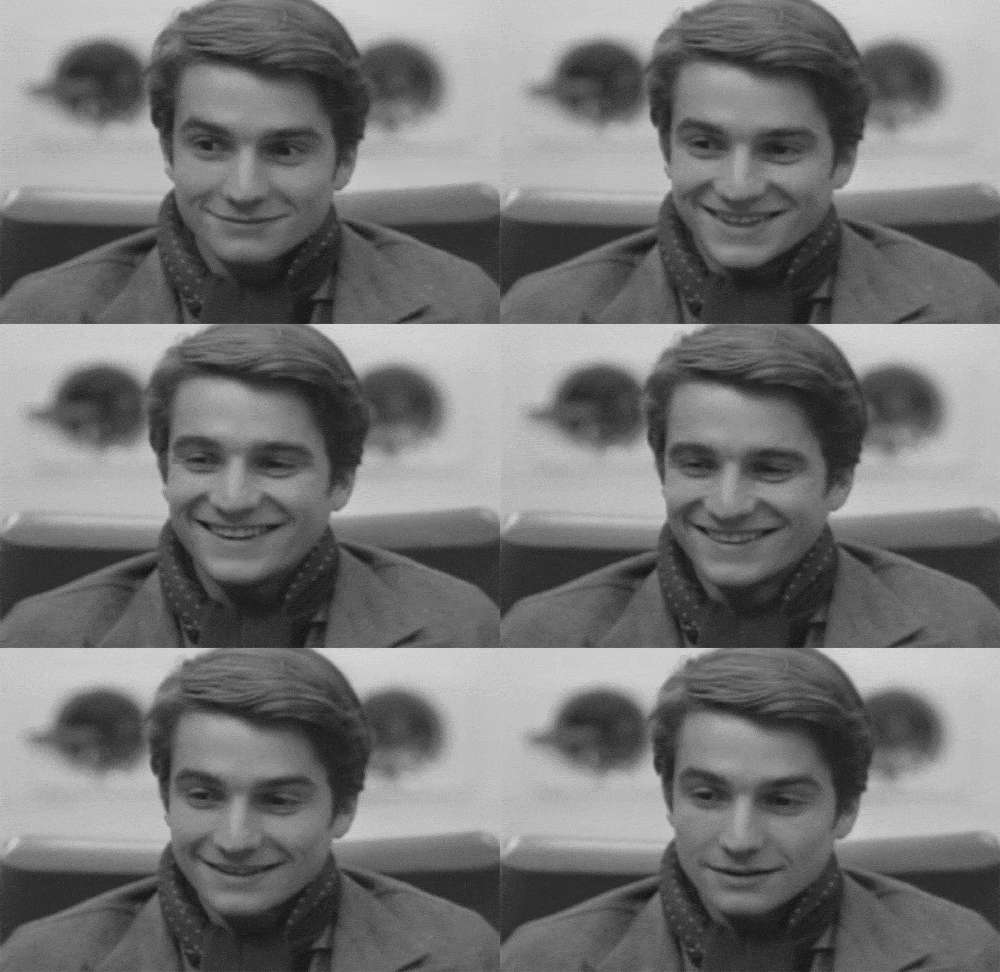
 The French New Wave was a film movement in early 1960’s France that broke all of the conventions of traditional movie making. Sick of prestigious studio films whose sole aim was to make money rather than present a distinct point of view, the New Wave filmmakers created films they wanted to see. Influenced by the Italian neo-realism movement, these directors worked outside the confines of a studio set, shooting right on the streets of Paris with natural lighting and handheld cameras. And Jean-Pierre Léaud was there right from the start: he was 14 when he played Antoine Doinel, the troubled and misguided youth in François Truffaut’s The 400 Blows, easily the greatest film about childhood ever made. The image of the New Wave, at least to the established guard, was that of a “youth gone wild”--both Truffaut and Godard, the movement’s two iconoclasts, were in their late 20’s/early 30’s when they began making films--and Léaud became a child of this New Wave. Not theatrically trained, he possessed a certain type of naturalism that worked magically with the sort of world the French New Wave sought to create. With no prior experience, he learned as he went, completely at the will of the director. And was he ever popular: between 1959 and 1973, he worked with cinematic giants such as Truffaut, Godard, Jacques Rivette, Jean Eustache, Pier Paolo Pasolini and Bernardo Bertolucci. Who besides Nicole Kidman can boast that wide of a variety of auteurs in such a short period?
 If you asked a group of cinephiles who their favorite French New Wave icon is, the amount of answers, unsurprisingly, would be wide and varied. Some of the “out there” members of this voting bloc might go with a quirky choice such as A Woman is a Woman star Jean-Claude Brialy. For the most part, however, a good majority of the votes would belong to Jean-Luc Godard’s muse (and wife for a brief period of time) Anna Karina and the sexy, rugged beacon of 60’s masculinity Jean-Paul Belmondo. As much as I love the above choices, for some time now, my heart has belonged to one New Wave icon alone: Jean-Pierre Léaud.


This madness would become part of Léaud's real life and a feature of his onscreen persona as it developed from the early 1990s. With Truffaut's death in October 1984, Léaud lost his mentor and protector. His dependence on this surrogate father had been reinforced by the director's insistence on paying him a monthly allowance rather than by the film; Truffaut academic Paul Michaud recalls that one month Truffaut withheld the money because of the state of the actor's personal hygiene and that the 35-year-old Léaud came to ask Truffaut to cut his hair and nails. Unsurprisingly, a period of psychological turmoil followed the film maker's death. Neighbours in Léaud's Parisian apartment block were said to have seen him stand ing naked in the courtyard waving a crucifix and bawling 'Back, Satan!' while in 1987 he assaulted an elderly woman he believed was spying on him with a flowerpot. He was given a three month suspended sentence; the psychiatric report stated that he was depressed following Truffaut's death.

 Susan Vance in Bringing Up Baby
 Scarlett O'Hara in Gone With the Wind
 Margo Channing in All About Eve
 Norma Desmond in Sunset Boulevard
 Antoine Doinel in Stolen Kisses
 Barbara Jean in Nashville
 Conrad Jarret in Ordinary People
 Posh Spice in Spice World
 Velma Kelly in Chicago
 Robert Ford in The Assassination of Jesse James by the Coward Robert Ford
 Groucho, Paul, Jean-Pierre, Claude, Cary